Showing posts with label Sustainability. Show all posts

Thursday, January 8, 2009

Green Resolutions

It' s that time of year to make resolutions for changes in our life. As people of faith with a responsibility for the stewardship of God's creation we need to make changes to live more sustainably and protect our environment for future generations.

Check out the environmental stewardship page on our church website for a few suggestions.

Have a great, green 2009!

Thursday, October 9, 2008

Plastic Bags


Plastic bags are polluting our environment and filling our landfills.

Our 5th grade Sunday School Class researched the environmental effects of plastic bags and put together a bulletin board display in the church education building.


Our environmental stewardship team has designed a "Going Green" reusable canvas bags with the church logo and is selling them to the congregation.

These bags will not only reduce the use of plastic bags but will show the community that our church is caring for God's creation.

Wednesday, March 12, 2008

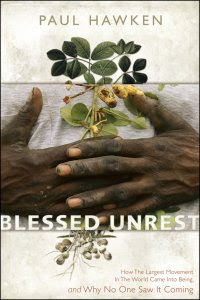
Blessed Unrest

Paul Hawken's latest book, Blessed Unrest, looks at the largest movement in the world that no one saw coming. That origins of the movement is the indigenous cultures, the environment and social justice.

Here is a short video (6 min.) of a speech by Paul Hawken which gives a good overview of the book. The large appendix at the back of the book is a great resource which categorizes the various groups , gives a description of their focus and the number of organizations in each category.

He has created a website, wiserearth.org , as a community forum for individuals and groups who are transforming the world.

I like his analogy comparing this movement to an immune system.

" This movement is humanities immune response to resist and heal political disease, economic infection and ecological corruption caused by ideologies."
Paul Hawken

Tuesday, January 29, 2008

Greening the Store Shelves


It use to be when you wanted eco-friendly cleaning supplies you had to go to a specialty store or order online. Now we have the first line of natural cleaners developed by a major consumer products company. Clorox has just come out with a line of cleaning supplies called Green Works and they have formed an alliance with Sierra Club to focus on environmental conservation and sustainability.

I hope this is just the beginning and other companies join a growing trend of more natural products.

Friday, December 21, 2007

An Earth-Friendly Christmas


Will your Christmas this year be Earth-friendly? Beside over- consuming our natural resources, we generate a record amount of trash during this time of year.

Merry Christmas to the landfills everywhere!

The environmental stewardship team at our church put together a list of Suggestions for an Earth-Friendly Christmas. Check it out, try a couple of ideas and lighten your impact on the environment this year.

Wednesday, October 31, 2007

Native American Spirituality


The main focus of Native American spirituality is the relationship of man with the land. Native Americans walk softly upon the Earth and have respect for all living things. A recent concert of the Carolina Master Chorale highlighted this. Several selections from Native American Ambiances by Jackson Berkey were performed. The words to one of the selections, The Web of Life, were especially meaningful.
This we know.
The earth does not belong to us, we belong to the earth.
All things are connected like the blood that unites one family.
Whatever befalls the earth befalls the children of the earth.
We do not weave the web of life; we are only a strand of it.
Whatever we do to the web, we do to ourselves.
The words are attributed to Chief Seattle of the Suquamish tribe and remind us that we need to learn to tread lightly on God's creation.

Sunday, August 5, 2007

The 11th Hour

Coming to a theater near you August 17th.

Tuesday, June 19, 2007

Our Throw Away Culture

Nearly 90% of the materials used in conventional manufactured goods in up in landfills, turning billions of dollars worth of material assets into costly, potentially harmful liabilities. The industrialized world has become better at manufacturing waste than making products.

In the book, Cradle to Cradle: Remaking the Way We Make Things, William McDonough and Michael Braungart point out two fundamental problems in the way we have designed products.
  1. We design products to thrown "away" when, in fact, there is no "away". The Earth is a finite, closed, living system. Our cradle-to-grave designs are affecting the health of our planet.
  2. We use material and chemicals that are unsafe and harmful to ourselves and our environment.
Wouldn't it be great if this would lead to a new sustainable industrial revolution?

Here is a great video of William McDonough speaking at the TED Conference.

Friday, June 8, 2007

World Ocean Day

June 8th is World Ocean Day.

Take some time to think about how we are affecting the oceans through global pollution and over-consumption of fish. We must learn to live more sustainably on planet Earth.

Friday, June 1, 2007

Eating Local

I have been reading a number of articles lately on the value of eating locally grown food. In the last 50 years we have seen both an industrialization and a globalization of our food supply. America is now a net importer of food. Our increasing diet of processed food has led to increasing rates of obesity and diabetes.

The current system of transporting food an average of 1,500 miles to our table will not be sustainable in a future of increasing energy costs and oil depletion.

Now is the time to make that visit to the local farmer's market a weekly happening. The food is fresher and tastes better, You are supporting the local economy and reducing the environmental pollution leading to global climate change.

Most of us are three to four generations removed from the farm. Many young children today don't know how vegetables grow. Maybe it's time to plant a garden this summer. Let your children help. They may even learn to like vegetables.

Thursday, May 10, 2007

Ecological Footprint


How big is your "ecological footprint"? This term was first coined by Prof. Bill Rees at University of British Columbia over a decade ago.

It is a metaphor used to depict the amount of land and area a human population would hypothetically need to provide the resources required to support itself and to absorb its waste, given prevailing technology.

Here is a questionnaire (pdf file) that can be used to calculate your ecological footprint and compare it to others around the world.

I can see this being a useful tool in a small discussion group at church and could lead to some good dialogue on sustainability and a Christian's responsibility.